

How Sexual Orientation Affects The Use Of Makeup And Cosmetics
Introduction
In our daily interactions, we ofttimes find some individuals more bonny than others. These evaluations of attractiveness are driven past our esthetic sense, which, according to Darwin (1871), evolved to facilitate good mating decisions by drawing usa to individuals who are, for instance, genetically healthy (come across also Dion et al., 1972; Thornhill and Gangestad, 1993, 1996; Thornhill and Grammer, 1999; Senior, 2003; Dissanayake, 2007).
More than generally, attractiveness besides plays a crucial role in our interactions with people. Attractive faces describe more attention and seem to demand longer looks. Attractive faces bind attention. Prove for this was provided by Shimojo et al. (2003) who asked participants to look at pairs of isolated faces. Participants then selected which of each pair of faces was more attractive. Participants looked longer at the more than attractive faces and this effect became even stronger every bit the time to select (recorded via cardinal press) the more attractive face up approached. The authors interpreted this equally a "gaze cascade issue," with liking increasing because of the longer looks.
Leder et al. (2010) found like effects of longer and more frequent looks to bonny faces, when faces were embedded in images of real-world scenes. They measured centre movements of participants who freely viewed (no task or decision required) faces that were embedded in images of real world scenes. The scenes consisted of urban street scenes with each scene depicting 2 aforementioned-sexual activity people who each represented one of two levels of attractiveness (bonny and less attractive, according to pre-studies)i. Results showed that attractive faces received longer and more than frequent looks. These results were corroborated with participants' subjective ratings: not simply were attractive faces rated as more bonny than less bonny faces, merely female faces were rated as more than bonny than male faces. Furthermore, differences between bonny and less attractive faces were larger for female than male person faces, and women provided college ratings for attractive faces than did men. Interestingly, Leder et al. (2010) besides found that women looked longest at attractive female faces.
The above results (e.g., Leder et al., 2010) raise an intriguing question regarding the roles of perceiver's sexual practice and sexual orientation on visual exploratory behavior. Regarding the former, studies have shown that the perceiver's sexual activity is indeed important. For case, attractiveness is not equally important for men and women, and men and women also distribute their attention differently. Alexander and Charles (2009) and Nummenmaa et al. (2012) showed that heterosexual men looked longer at female than male person faces; in contrast, heterosexual women distributed their attending more than evenly between the sexes. Lykins et al. (2008) likewise equally State of israel and Strassberg (2009) too found that heterosexual men and women looked longer at people of the other sexual practice as compared to people of the same sexual activity. Some authors have additionally reported evidence that attractiveness is generally more important for heterosexual than for homosexual individuals, and that it is more important for heterosexual men and homosexual men than for heterosexual women, and least important for homosexual women (Bailey et al., 1994; Russock, 2011; Ha et al., 2012). All of these studies suggest that the factors sex of the perceiver and sexual practice of the perceived face should both be taken into account in studies of facial bewitchery. These two factors, forth with sexual orientation, are central topics in the nowadays study.
Regarding sexual orientation, at that place are differences between heterosexual and homosexual individuals in much the same way every bit there are differences betwixt men and women (e.g., that attractiveness is more of import for men than for women). Such differences have been found at the neurological level (Swaab and Hofman, 1990; LeVay, 1991; Savic and Lindström, 2008). For example, Kranz and Ishai (2006) and Ishai (2007) reported show that certain brain responses associated with advantage are adamant to a corking extent by perceivers' sexual orientation. They showed pictures of male and female faces to heterosexual and homosexual men and women who then rated the attractiveness of the faces. During the rating chore, heterosexual women and homosexual men showed similar brain activity in the thalamus and medial orbitofrontal cortex (measured with functional magnetic resonance imaging) when seeing faces of men; and heterosexual men and homosexual women when seeing faces of women. The orbitofrontal cortex receives input from the thalamus, and the medial orbitofrontal cortex is involved with processing of reward. Other evidence also suggests that faces matching perceivers' sexual orientation are more important and attract more attention than sexually non-preferred faces. Lippa (2012) institute that heterosexual and homosexual men and women rated pictures of the preferred sex every bit more attractive and looked at them longer. Men did not charge per unit pictures of the non-preferred sex equally more attractive as bewitchery increased; women, still, rated both sexes more than attractive with increasing attractiveness. Moreover, for homosexual men, durations of looks did not increase with increasing attractiveness of either their preferred or non-preferred sex. Through an middle tracking experiment, Fromberger et al. (2011) also examined the effects of sexual orientation. In their written report, heterosexual men looked at various pictures showing men (considered to exist non-preferred in a sexual regard because of their sex), boys and girls (considered to be not-preferred in a sexual regard considering of their age), and women (considered to be sexually preferred in terms of sex and mating). Results showed that participants looked outset, and for longer durations, at the sexually preferred faces. These results further highlight the importance of taking sexual orientation into business relationship when conducting research on the perception of others.
In guild to disentangle the diverse factors involved in facial bewitchery, and its behavioral consequences, we conducted a written report that examined how an individual'southward sex and sexual orientation influence visual exploratory behavior toward, and evaluations of, faces. A noteworthy deviation betwixt heterosexual and homosexual individuals is that for the former group, other sexual practice people represent possibilities for both romantic partnership and reproduction; for the latter group, romantic partnership takes precedence. However, existence oriented toward one's own sexual activity of class does not forbid the desire to have children.
Every bit indicated in the above literature review, looking beliefs seems to be a suitable measure of sexual involvement or attraction. We therefore used eye tracking in the present report and analyzed looks toward each of ii faces that varied in levels of bewitchery and that were embedded in images of existent earth scenes (every bit in Leder et al., 2010). We analyzed the mean number of fixations and total fixation duration to each of the more and the less attractive faces in the scenes. Additionally we gathered bewitchery ratings of the faces to have an additional, overt measure out with which to compare the behavioral effects. We expected that: (1) participants would generally look longer at the bonny than the less attractive faces; (2) by including participants' sexual orientation as a gene, looks at bonny faces should be longer for faces that friction match participants' sexual orientation; (three) the attractiveness of faces matching participants' sexual orientations is expected to have stronger effects for men—both heterosexual and homosexual—than for women, which ways that men would look longer at the faces of their preferred sexual activity than women, a prediction derived from the higher up studies (east.g., Alexander and Charles, 2009; Nummenmaa et al., 2012) showing that in general, attractiveness has a greater consequence on men; and (iv) the divergence betwixt the durations of looks at attractive and less attractive faces should exist more pronounced for men than for women, and that heterosexual and homosexual women are expected to look at all faces similarly long.
Materials and Methods
Participants
Twoscore participants (20 men, 20 women; mean age, 23.38 years) participated in the report. Twenty participants were heterosexual (ten men, 10 women; mean age, 23.7 years) and were undergraduate students from the University of Vienna who participated for class credit. The 20 self-identified homosexual participants (x men, ten women; hateful age, 23.05 years) consisted of both undergraduate students and participants recruited via the Internet (e.g., social networks, appropriate websites). The study was advertised as a visual perception written report in which eye tracking will exist used and that experimenters were looking for heterosexual and homosexual men and women who would like to participate. Prior to the start of the report, each participant reviewed and signed a consent form. Participants' visual acuity, oculomotor authority, color vision, and handedness were tested prior to the primary written report. All participants had normal or corrected-to-normal vision.
Materials
To exam our hypotheses, we used 35 images of real world scenes with each depicting ii people of the same sex, with ane of them being attractive and the other less bonny (17 pairs of women, 18 pairs of men; with bewitchery based on pre-written report data as described below; encounter Figure 1A). In club to conceal the aim of the study and to create a natural "urban walk-like" sequence of scenes, the scenes were randomly mixed with eight filler scenes containing either an attractive woman paired with a less attractive man or vice versa (see Figure 1B). There were an additional 51 images of real world scenes without people, which were besides used equally filler scenes (every bit in Leder et al., 2010; run into Effigy 1C).
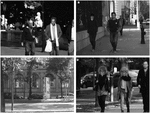
FIGURE one. Stimuli examples. (A) Instance of a same-sex scene showing a less attractive male person (left) and bonny male (correct) (B) Example of a filler scene showing a less attractive female (left) and bonny male (correct) (C) Example of a filler scene without people (D) Example of a same-sex activity scene showing a less bonny female (left) and attractive female person (right) with corresponding AOIs. Faces are blurred for reasons of anonymity.
As in Leder et al. (2010), we replaced the faces in the original images of real world scenes with pre-selected and pre-rated attractive and less attractive faces of women and men. We wanted to apply natural-looking stimuli and non isolated faces (as did e.grand., Shimojo et al., 2003) in lodge to obtain a fix of scenes that was more than ecologically valid. In order to experimentally control for facial attractiveness, the original faces were replaced. This helped to ensure that 1 confront was clearly more attractive than the other. To create the stimuli, nosotros offset collected a ready of faces that would exist used to replace the original faces in the scenes. Three people collected faces independently of each other. The post-obit criteria guided the drove process: the individuals' subjective evaluation of attractiveness (attractive, less attractive); faces with neutral expressions; faces with closed mouths and no teeth, smile, or facial jewelry visible; and for faces of men, no facial hair. To ensure that we had plenty attractive and less bonny faces that would match the bodies in the original pictures, we collected a large pool of such faces. We performed two pre-studies to validate, and augment the rigor of, the initial face pick process as described above. In the commencement pre-study (n = 16), we established the attractiveness of the collected faces. Only faces that were conspicuously rated as bonny and less attractive were then used for the replacement of the original faces. In order to minimize the furnishings of dress, tiptop, and position, the faces were counterbalanced over the left-right positions in the same-sexual activity scenes (i.e., the test scenes). Later on the scenes were produced, we conducted the second pre-study (northward = 16), which verified that the faces were withal bonny (or less attractive) later on being placed on the unlike bodies. In this second pre-study, participants saw both versions of each scene (attractive face on the left and less attractive face on the correct, less bonny face up on the left and attractive face on the right) and rated the bewitchery of each of the two people depicted and decided which of the two was more attractive. These pre-study participants rated a total of 58 aforementioned-sex scenes.
In the main study, nosotros only included those 35 same-sex activity scenes from the pre-study in which the divergence in attractiveness betwixt the mean attractiveness ratings of the faces (within a scene) was at least 1.v (on a 5-point-scale). Additionally, participants saw the to a higher place-described 59 filler scenes. Each participant in the main report viewed a total of 94 scenes.
Procedure and Design
Nosotros employed a mixed-model pattern with the sexual orientation of the participants as the between-subject factor and the sex and attractiveness of the faces in the scenes every bit inside-subject factors. The study consisted of two blocks. The outset block involved a gratuitous-viewing task during which an EyeLink 1000 Desktop Mountain eye tracker (SR Research Ltd., Mississauga, ON, Canada) recorded centre movements (left middle) at yard Hz frequency in a dimly lit room. The participants sat 62 cm abroad from the 24-inch Samsung SyncMaster 2443BW LCD monitor (widescreen; 16:nine; resolution: 1920 × 1200 pixel; refresh rate lx Hz) while brow and chin rests stabilized their heads. The study was run on a computer using Windows XP and was controlled using Experiment Builder (SR Enquiry Ltd.) software. Participants viewed all 94 scenes, with left-right positions counterbalanced between participants (59 filler and 35 same-sex scenes with 17 women and 18 men). The participants read the instructions, which stated that the aim of the written report was to study visual perception beliefs, that they should look at and explore the pictures freely as they wanted, and that at that place was no task involved. After the instructions were read, we performed a ix-point calibration check prior to each study. Each trial started with a fixation-cross in the middle of the screen. By fixating on the cantankerous, the participant triggered the next stimulus. If there was no fixation during v due south, the program showed an error message and a 5-point recalibration was performed. Each scene was presented for 10 s and participants' eye movements were recorded during this flow. We analyzed simply fixations on the two faces for each scene and did non include the filler scenes in the analysis. Nosotros defined the areas covering each face as Areas of Interests (AOIs). AOIs were round in shape and covered each face area. The size of the AOIs was 100 pixels in diameter for all scenes (encounter Figure 1D). The dependent variables for this role of the written report were the hateful full fixation duration and mean number of fixations within the AOIs. We excluded blinks and saccades from the analysis.
The 2d block was used to farther validate the bewitchery of the faces. In this block, participants rated the bewitchery of all of the faces that they saw in the offset block. Participants sat in front end of a 24-inch Samsung SyncMaster 2443BW LCD monitor (widescreen; sixteen:9; resolution: 1920 × 1200 pixel; refresh rate lx Hz) and used a keyboard to input their ratings. Subsequently participants read the instructions stating that they volition meet the pictures that they saw before and that they should rate the bewitchery of the faces, participants viewed each same-sex scene twice. Whether the left or the right face was the first to be rated was randomized between participants. The participants provided ratings of all faces on a seven-indicate calibration ranging from 1 (very unattractive) to 7 (very attractive). The mean attractiveness rating for each face served as the dependent variable in the second block.
Participants did not provide facial bewitchery ratings immediately after they explored the picture to ensure that their automated, implicit response (showtime block) was isolated from the explicit responses to bewitchery that they provided during the evaluation task (second block). The presentation order of the scenes in the commencement and 2d blocks was randomized. After the study, participants completed a questionnaire regarding demographic information, relationship status, and sexual orientation. Finally, they were debriefed almost the purpose of the report. The study was canonical by the Ideals Committee of the University of Vienna.
Results
The results are reported separately for the eye movement data and the attractiveness rating data. In all analyses reported, bewitchery (attractive, less attractive) and sex activity (faces of men and women, labeled as sex of face) of the embedded faces were inside-subject factors, and sexual orientation (homosexual, heterosexual) of the participants was the between-subject factor. We did not include the participants' relationship condition equally a factor in the assay since the grouping sizes associated with this factor would accept been too small. Throughout the results section, all pairwise comparisons are Bonferroni-corrected.
Center Motility Information
Hateful Total Fixation Duration
Tables 1 and 2 show the means ("fixation elapsing") sampled over participants separately for sexual activity of participant (Tabular array 1 male, Table ii female participants). All analyses comprised a ii (sexual orientation: heterosexual, homosexual) × 2 (sex of face: man, woman) × 2 (attractiveness: bonny, less attractive) mixed factorial repeated measures analysis of variance (ANOVA) design; the effect sizes for main effects and interactions of the reported ANOVAs are presented in Tables 3–8. The results are summarized in Effigy ii. For the male participants, there was a significant primary effect of attractiveness, F(1,18) = 40.09, p < 0.001, = 0.69 (encounter Table iii). Bonny faces were looked at longer than less attractive faces. There was also a meaning interaction among attractiveness, sexual practice of face, and sexual orientation, F(i,18) = 17.48, p < 0.01, = 0.50. Post hoc pairwise comparisons revealed that heterosexual men looked longer at less bonny faces of men than homosexual men (p < 0.05), that heterosexual men looked longer at attractive female faces than less attractive female faces (p < 0.001), that homosexual men looked longer at attractive female person faces than less attractive female faces (p < 0.01), and that homosexual men looked longer at attractive male faces than less attractive male person faces (p < 0.001). Furthermore, heterosexual men looked longer at less attractive male faces than less bonny female person faces (p < 0.01), but they looked longer at attractive female faces than attractive male faces (p < 0.05). For the female participants, the same ANOVA revealed significant main effects of attractiveness, F(1,18) = 17.56, p < 0.01, = 0.49 and sex of face, F(i,18) = five.32, p < 0.05, = 0.23 (come across Table 5). Bonny faces were looked at longer than less bonny faces and male person faces were looked at longer than female person faces.
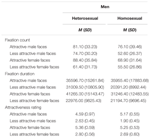
Table one. Mean number of fixations (Fixation Count) and mean full fixation elapsing (Fixation Duration) on attractive and less attractive male person and female person faces and mean attractiveness ratings (Bewitchery rating) for attractive and less attractive male person and female faces for heterosexual and homosexual men.
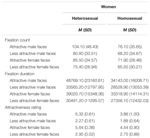
TABLE two. Hateful number of fixations (Fixation Count) and mean total fixation duration (Fixation Duration) on attractive and less attractive male person and female faces and hateful attractiveness ratings (Attractiveness rating) for attractive and less attractive male and female faces for heterosexual and homosexual women.

Table 3. Analysis of Variance for mean total fixation duration for male participants.
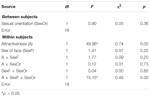
TABLE 4. Analysis of variance for mean number of fixations for male participants.
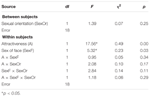
Table 5. Analysis of variance for mean total fixation elapsing for female participants.

TABLE half-dozen. Analysis of variance for hateful number of fixations for female person participants.
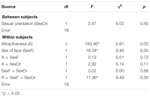
TABLE 7. Analysis of variance for hateful attractiveness ratings for male person participants.
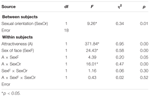
TABLE viii. Assay of variance for mean attractiveness ratings for female participants.

FIGURE 2. Mean total fixation duration on attractive and less attractive female and male faces for heterosexual and homosexual women (left) and heterosexual and homosexual men (right). Fault bars represent ± i SE.
Hateful Number of Fixations
Tables ane and two present the ways ("fixation count") sampled over participants separately for sex of participant (Table ane male, Tabular array 2 female participants). Regarding the mean number of fixations, the ANOVA for the male person participants revealed a significant chief effect of attractiveness, F(1,xviii) = 49.96, p < 0.001, = 0.74 (see Table 4). Attractive faces were looked at more often than less attractive faces. The interaction amongst attractiveness, sex of face, and sexual orientation was also meaning, F(1,18) = fifteen.fifteen, p < 0.01, = 0.46. Postal service hoc pairwise comparisons revealed that heterosexual men looked more often at attractive female faces than less bonny female person faces (p < 0.001), that homosexual men looked more oft at bonny female faces than less attractive female faces (p < 0.01), and that homosexual men looked more oftentimes at attractive male faces than less bonny male person faces (p < 0.001). And, heterosexual men looked more oft at less bonny male faces than less attractive female faces (p < 0.01). For the female person participants, the ANOVA only revealed a pregnant main effect of attractiveness, F(1,eighteen) = 8.26, p < 0.05, = 0.31 (see Table six). Attractive faces were looked at more oft than less attractive faces.
Behavioral Data
Tables 1 and 2 also show the means of the attractiveness ratings sampled over participants (Table 1 male person, Table 2 female participants). Table vii (male person participants) and Table 8 (female participants) evidence the effect sizes for the main effects and interactions of the reported ANOVAs. The ANOVA on mean bewitchery ratings for the male participants revealed significant main furnishings of bewitchery, F(1,eighteen) = 183.46, p < 0.001, = 0.91, and sex of face, F(1,eighteen) = xvi.34, p < 0.01, = 0.48. Attractive faces were rated every bit more attractive than less attractive faces and female faces were rated every bit more than attractive than male faces. There was a significant interaction amongst bewitchery, sex of face, and sexual orientation, F(1,18) = 17.36, p < 0.01, = 0.49. Postal service hoc pairwise comparisons revealed that heterosexual men rated less attractive male faces as more attractive than homosexual men (p < 0.01), that heterosexual men rated attractive female person faces as more bonny than less attractive female faces (p < 0.001), that homosexual men rated attractive female faces as more attractive than less attractive female faces (p < 0.001), that heterosexual men rated attractive male faces as more bonny than less attractive male faces (p < 0.001), and that homosexual men rated attractive male faces every bit more attractive than less attractive male faces (p < 0.001). Furthermore, heterosexual men rated bonny female person faces equally more attractive than attractive male faces (p < .01). Furthermore, homosexual men rated less attractive female faces as more attractive than less attractive male person faces (p < 0.001). For the female person participants, the ANOVA revealed meaning master effects of attractiveness, F(1,18) = 371.84, p < 0.001, = 0.95, sexual orientation, F(one,18) = 9.26, p < 0.01, = 0.34, and sexual activity of face, F(1,18) = 24.43, p < 0.001, = 0.58. Bonny faces were generally rated as more than attractive than less attractive faces, heterosexual women rated faces as more bonny than homosexual women, and female faces were rated equally more attractive than male faces. At that place was a significant interaction between attractiveness and sexual orientation, F(1,xviii) = 16.01, p < 0.01, = 0.47. Post hoc pairwise comparisons revealed that heterosexual women rated attractive faces as more bonny than homosexual women (p < 0.001), that heterosexual women rated bonny faces as more than attractive than less bonny faces (p < 0.001), and that homosexual women rated faces as more than bonny than less attractive faces (p < 0.001).
Discussion
Facial attractiveness plays an important role during our interactions with others in the world. While it has been demonstrated that we await longer at attractive people, information technology has not been shown how this upshot is associated with sexual orientation, in detail when the to be rated faces or persons are seen in a natural context. We examined the visual perception and evaluation—through measures of heart movements and attractiveness ratings—of heterosexual men and women and homosexual men and women toward images of attractive and less attractive men and women embedded in images of real world, urban street scenes.
The visual perception and evaluation of faces varying in attractiveness converged in this report. Pre-selected attractive faces, independent of their sex, were looked at longer and more than often, and were rated as more attractive, as compared to less attractive faces. In nearly all comparisons, the faces pre-selected equally attractive were rated as significantly more than bonny and were likewise looked at significantly more often and longer than the less attractive faces. Despite an overall potent tendency to look longer at attractive faces, nosotros also discovered systematic variations in the way attractiveness draws longer looks in participants with dissimilar sexual orientations.
What did the examination of participants' eye movements reveal nearly the relative importance of sexual orientation? Nosotros found that of the 3 principal factors in the study (facial bewitchery, sex of the confront, and participants' sexual orientation), level of attractiveness was most relevant, as indicated by the fact that participants looked longer and more than often at attractive faces than less attractive faces. This is a upshot that we had expected. However, sexual orientation had a disquisitional moderating effect, as indicated past the finding that participants—except for homosexual women—looked longer and more oft at bonny faces that matched their sexual orientations than faces of the other sexual activity. For homosexual women, the differences between sexually preferred and non-preferred faces were quite small.
In contrast to homosexual men and heterosexual women, heterosexual men and homosexual women did not await longer at attractive male faces as compared to less attractive male person faces (encounter Tables 1 and 2). The interactions in both dependent measures (hateful number of fixations, hateful full fixation elapsing) point that responses toward attractiveness for male participants varied as a function of sexual orientation. Interestingly, heterosexual and homosexual men and homosexual women looked longer and more often at the less attractive confront of their not-preferred sex than the less attractive face up of their preferred sexual practice. Information technology seems that faces that are less bonny, but of the preferred sex, have an aversive graphic symbol and therefore received the to the lowest degree corporeality of attention. This finding is consistent with the findings of, for example, Kampe et al. (2001) and Cloutier et al. (2008). When less attractive faces were presented Cloutier et al. (2008) found activation in the lateral orbitofrontal cortex, a region that is associated with penalty (see O'Doherty et al., 2001). Heterosexual men looked longer and more often at bonny female faces every bit compared to less attractive female faces and also as compared to attractive male faces, a finding that is consistent with their sexual orientation. Too consistent is the finding that male faces and their attractiveness are less important to heterosexual men (the differences betwixt attractive and less attractive male faces for both dependent measures were not significant in mail service hoc pairwise comparisons). A possible caption of why heterosexual men looked similarly long at the ii types of male person faces is intra-sexual comparison: heterosexual men may have compared themselves with the men in the pictures. Heterosexual men differed from homosexual men and heterosexual women in this regard with the latter 2 groups both showing clear differences in looking behavior between attractive and less attractive male and female person faces. These latter effects stand for to the sexual orientations of homosexual men and heterosexual women. Heterosexual women looked longer at attractive male faces than attractive female faces. Although this finding corresponds to heterosexual women'southward sexual orientation, it contrasts the results of Leder et al. (2010), who found that women looked longer at female person faces as compared to male faces and that women looked longest at attractive female faces.
Attractiveness affected homosexual women to the lowest degree, as this group of participants did not look more than ofttimes or longer at attractive male faces and not more often at attractive female faces as compared to the less attractive counterparts. This is in accordance with the results of Bailey et al. (1994) and Ha et al. (2012). For homosexual women, in comparing to the other participant groups, the differences between attractive and less attractive faces, regardless of the sex of the face, were much smaller—merely near half the size. Still, when looking at two female faces, homosexual women looked longer at the attractive female face. Interestingly, and somehow unexpectedly, homosexual women looked longer and more ofttimes at male faces equally compared to female faces when attractiveness is not taken into account. This can exist seen in Table 2 when combining the values of less bonny and more than bonny male faces and comparing them to the combination of less bonny and more than attractive female faces. What are possible explanations for this finding? Visual attending toward men could indeed be a sign of some biological interest associated with a wish to reproduce. Alternatively, this effect might reflect cautious behavior toward men, who are generally seen as more aggressive and threatening than women (Leder et al., 2010, Experiment 2). All the same, if this latter explanation were correct, then attractive and less attractive male faces would have received like amounts of attending. This was not the example. Thus, while this effect might bespeak a biological wish for reproduction, the effects of attractiveness for homosexual women are—every bit expected—rather weak; the differences in the dependent variables between attractive and less attractive faces are small-scale (Bailey et al., 1994). The differences betwixt bonny and less attractive faces are smaller compared to the other participant groups.
When analyzing participants' attractiveness ratings of one attractive and one less attractive face in scenes depicting two people of the same sex, we found that in general, attractive faces were rated as more bonny as compared to less attractive faces. This serves as a manipulation check and shows that our experimental manipulation succeeded. With respect to participants' sexual orientation, it can be said that the post-obit findings associated with homosexual women and heterosexual men are indicative of the ascendant furnishings of sexual orientation: homosexual women rated faces matching their sexual orientation; that is, they rated female faces equally more than attractive than male faces, regardless of the level of facial attractiveness. Similarly, heterosexual men rated faces matching their sexual orientation. This pattern, which was also shown by heterosexual women and homosexual men, is unexpected for these groups of participants considering information technology does not match their sexual orientation; however, it tin exist said that heterosexual women's ratings are in accord with Leder et al. (2010).
It is interesting that heterosexual men rated less attractive male person faces as more attractive as compared to homosexual men. Consequent with this finding is that homosexual men rated less attractive female faces equally more than attractive every bit compared to less attractive male faces. Again, it seems that less bonny faces that match the participants' sexual orientation somehow seemed aversive.
Thus, our data show how sexual orientation affected beliefs. The hypothesis that attractive faces receive more attention than less attractive faces was also generally supported. Our findings are also in accordance with previous findings that bewitchery is less important to homosexual women (Bailey et al., 1994; Ha et al., 2012).
A limitation of our report is that nosotros determined participants' sexual orientation categorically instead of using a scale. It cannot be ruled out that some of our (cocky-identified) heterosexual and homosexual participants could have tended more toward bisexuality. However, the fact that the homosexual participants indicated their sexual orientation as homosexual, and the fact that we plant effects consistent with these classifications, lend some back up for the validity of our approach.
Other variables with additional explanatory value, and that could be the focus of time to come research, are the participants' relationship status and their desire to have children. Future studies could focus on sexual attractiveness, but non general attractiveness as this study did. A heterosexual human could rate some other man as attractive—in the sense of full general appearance. This does not necessarily mean he is sexually attracted to him. From a Darwinian standpoint, one would expect the differences in such attractiveness ratings for female and male faces to be more pronounced as found in this study. Heterosexual men, and to a lesser degree homosexual women, should clearly prefer female faces, whereas homosexual men and heterosexual women should clearly prefer male person faces. Nevertheless, sexually non-preferred faces that are attractive should receive higher ratings from homosexual individuals because homosexual individuals are besides interested in having children (Wyers, 1987; Mondimore, 1996; Lippa, 2007; Gates, 2008, 2013a,b). However, disentangling these factors is difficult within the context of the present study.
The present written report suggests that our visual exploratory behavior is strongly determined past beauty. Beauty demands longer looks, and indeed, bonny faces received longer looks. But when it comes to such behaviors, our findings emphasize the importance of sexual orientation. It could thus be causeless that the processing of bewitchery manifests itself through a combination of sexual orientation and the specific motivations and goals of an individual. Sexual orientation directly affects the processing of attractiveness and is aligned with visual behavior. Our findings are relevant for the pattern of studies in which facial attractiveness, and its consequences on the perceiver, are addressed. Ignoring inter-private differences, such every bit the sexual orientation, might reveal an overly simplistic image. Finally, our use of existent-world scenes demonstrates that tight experimental control could be successfully balanced with ecological validity.
Author Contributions
AM was involved in the planning of the design of the experiment, created a part of the used stimuli, nerveless, analyzed and interpreted the data. She wrote the manuscript and revised information technology. HL was involved in the planning of the design and interpretation of the results, wrote parts of and revised the manuscript. He gave his blessing of the version to be published. PT was likewise involved in the planning of the pattern, created a part of the used stimuli, and helped with the interpretation of the data. He wrote parts of the manuscript and revised it. He also gave his approval of the version to be published.
Funding
This research is supported by grants P23538 and P27355 of the Austrian Science Fund to HL.
Disharmonize of Interest Statement
The authors declare that the enquiry was conducted in the absenteeism of any commercial or financial relationships that could be construed as a potential conflict of interest.
Acknowledgments
The authors would similar to thank Marcel Cimander and Dalibor Mitrovic for their contributions to this piece of work, and Isabella Fuchs-Leitner and Andreas Gartus for their support in information analyses.
Footnotes
- ^Throughout the manuscript, we volition omit the use "pre-selected" to maintain the flow of reading. Each mention of bonny or less bonny faces are based on pre-studies that established the levels of attractiveness.
References
Alexander, G. M., and Charles, N. (2009). Sexual activity differences in adults' relative visual interest in female and male faces, toys, and play styles. Curvation. Sex. Behav. 38, 434–441. doi: 10.1007/s10508-008-9429-7
PubMed Abstruse | CrossRef Full Text | Google Scholar
Bailey, J. 1000., Gaulin, S., Agyei, Y., and Gladue, B. (1994). Effects of gender and sexual orientation on evolutionary relevant aspects of man mating psychology. J. Pers. Soc. Psychol. 66, 1081–1093. doi: 10.1037/0022-3514.66.6.1081
PubMed Abstract | CrossRef Full Text | Google Scholar
Cloutier, J., Heatherton, T. F., Whalen, P. J., and Kelley, W. 1000. (2008). Are attractive people rewarding? Sex differences in the neural substrates of facial attractiveness. J. Cogn. Neurosci. twenty, 941–951. doi: 10.1162/jocn.2008.20062
PubMed Abstract | CrossRef Total Text | Google Scholar
Darwin, C. (1871). The Descent of Man, and Selection in Relation to Sexual activity. London: Murray.
Google Scholar
Dion, K., Berscheid, E., and Walster, East. (1972). What is beautiful is adept. J. Pers. Soc. Psychol. 24, 285–290. doi: 10.1037/h0033731
CrossRef Full Text | Google Scholar
Dissanayake, Eastward. (2007). "What art is and what fine art does: An overview of contemporary evolutionary hypotheses," in Evolutionary and Neurocognitive Approaches to Aesthetics, Inventiveness and the Arts, eds C. Martindale, P. Locher, and V. M. Petrov (Amityville, NY: Baywood), 1–14.
Google Scholar
Fromberger, P., Jordan, Thousand., von Herder, J., Steinkrauss, H., Nemetschek, R., Stolpmann, G., et al. (2011). Initial orienting towards sexually relevant stimuli: preliminary evidence from eye motility measures. Arch. Sex. Behav. 41, 919–928. doi: 10.1007/s10508-011-9816-3
PubMed Abstract | CrossRef Full Text | Google Scholar
Gates, K. (2008). "Diversity amongst same-sexual activity couples and their children," in American Families: A Multicultural Reader, ed. S. Coontz (New York, NY: Routledge), 394–399.
PubMed Abstruse | Google Scholar
Ha, T., van den Berg, J. E., Engels, R. C., and Lichtwarck-Aschoff, A. (2012). Effects of bewitchery and condition in dating desire in homosexual and heterosexual men and women. Arch. Sex. Behav. 41, 673–682. doi: ten.1007/s10508-011-9855-9
PubMed Abstract | CrossRef Full Text | Google Scholar
Israel, Eastward., and Strassberg, D. Southward. (2009). Viewing fourth dimension equally an objective measure of sexual interest in heterosexual men and women. Arch. Sexual practice. Behav. 38, 551–558. doi: ten.1007/s10508-007-9246-four
PubMed Abstract | CrossRef Full Text | Google Scholar
Leder, H., Tinio, P. P. L., Fuchs, I., and Bohrn, I. (2010). When attractiveness demands longer looks: the effects of situation and gender. Q. J. Exp. Psychol. 63, 1858–1871. doi: ten.1080/17470211003605142
PubMed Abstract | CrossRef Total Text | Google Scholar
LeVay, Due south. (1991). A difference in hypothalamic construction between heterosexual and homosexual men. Science 253, 1034–1037. doi: ten.1126/science.1887219
CrossRef Full Text | Google Scholar
Lippa, R. A. (2007). The preferred traits of mates in a cantankerous-national study of heterosexual and homosexual men and women: an examination of biological and cultural influences. Arch. Sex. Behav. 36, 193–208. doi: ten.1007/s10508-006-9151-2
PubMed Abstruse | CrossRef Full Text | Google Scholar
Lippa, R. A. (2012). Effects of sex and sexual orientation on self-reported attraction and viewing times to images of men and women: testing for Category Specificity. Curvation. Sex. Behav. 41, 149–160. doi: 10.1007/s10508-011-9898-y
PubMed Abstruse | CrossRef Full Text | Google Scholar
Lykins, A. D., Meana, M., and Strauss, One thousand. P. (2008). Sex activity differences in visual attention to erotic and not-erotic stimuli. Arch. Sex. Behav. 37, 219–228. doi: ten.1007/s10508-007-9208-x
PubMed Abstract | CrossRef Full Text | Google Scholar
Mondimore, F. M. (1996). A Natural History of Homosexuality. Baltimore: The John Hopkins University Press.
Google Scholar
Nummenmaa, Fifty., Hietanen, J. K., Santtila, P., and Hyönä, J. (2012). Gender and visibility of sexual cues influence eye movements while viewing faces and bodies. Arch. Sexual activity. Behav. 41, 1439–1451. doi: 10.1007/s10508-012-9911-0
PubMed Abstruse | CrossRef Total Text | Google Scholar
O'Doherty, J., Kringelbach, G. L., Rolls, E. T., Hornak, J., and Andrews, C. (2001). Abstract advantage and penalisation representations in the human orbitofrontal cortex. Nat. Neurosci. 4, 95–102. doi: ten.1038/82959
PubMed Abstract | CrossRef Full Text | Google Scholar
Russock, H. I. (2011). An evolutionary interpretation of the effect of gender and sexual orientation on human mate choice preferences, equally indicated past an analysis of personal advertisements. Behaviour 148, 307–323. doi: x.1163/000579511X556600
CrossRef Full Text | Google Scholar
Savic, I., and Lindström, P. (2008). PET and MRI bear witness differences in cerebral asymmetry and functional connectivity between human- and heterosexual subjects. Proc. Natl. Acad. Sci. U.S.A. 105, 9403–9408. doi: x.1073/pnas.0801566105
PubMed Abstruse | CrossRef Full Text | Google Scholar
Swaab, D. F., and Hofman, M. A. (1990). An enlarged suprachiasmatic nucleus in homosexual men. Brain Res. 537, 141–148. doi: 10.1016/0006-8993(90)90350-K
CrossRef Full Text | Google Scholar
Thornhill, R., and Gangestad, S. W. (1996). The evolution of human sexuality. Trends Ecol. Evol. 11, 98–102. doi: 10.1016/0169-5347(96)81051-two
CrossRef Total Text | Google Scholar
Thornhill, R., and Grammer, Thou. (1999). The body and confront of adult female: one decoration that signals quality? Evol. Hum. Behav. xx, 105–120. doi: 10.1016/S1090-5138(98)00044-0
CrossRef Total Text | Google Scholar
Wyers, Due north. L. (1987). Homosexuality in the family: lesbian and gay spouses. Soc. Work 32, 143–148.
Google Scholar

How Sexual Orientation Affects The Use Of Makeup And Cosmetics,
Source: https://www.frontiersin.org/articles/10.3389/fnhum.2016.00122/full
Posted by: williamswasioneating.blogspot.com
0 Response to "How Sexual Orientation Affects The Use Of Makeup And Cosmetics"
Post a Comment